English
Intent
At St Nicholas of Tolentine, we believe that offering a high-quality English curriculum will enable children to become fluent, confident and articulate communicators who can read, write, listen and speak confidently and enjoy doing so! These skills are applicable to not only English, but are also fundamental to learning across the curriculum and into wider life. Our Reading and Writing lessons, based on high-quality children's books, are linked so that vocabulary explored in Reading can be transferred to Writing lessons.
Implementation
Phonics
Every member of staff is trained in the Unlocking Letters and Sounds accredited scheme.
Phonics is taught daily in EYFS, Year 1 and the first 2 terms of Year 2, with regular interventions to support individual pupils.
At the end of Year 1, children sit a Phonics Screening Check, comprised of 40 decodable real and 'alien' words. Those who do not pass will receive extra intervention throughout Year 2 and beyond.
Children who are learning phonics take home a 'decodable' reading book to develop fluency with sounds they already know.
See our Phonics page for more information.
Reading
At St Nicholas of Tolentine, we have created our own Reading Spine of high-quality texts that are used in English lessons from Reception right the way up to Year 6. These texts have a close link to the class topic, immersing the children in science, history and geography. When choosing these texts, our curriculum team ensure that a range of non-fiction, fiction and poetry are covered as well as ensuring a diversity of characters and settings. We recognise the importance of children seeing themselves in the literature that they are exposed to.
In Reading lessons throughout Key Stages one and two, one reading domain is taught weekly: retrieval, inference, prediction, summary, sequencing and author choice. Pupils are given the opportunity to explore these themes creatively through games, role play and drawing as well as being equipped with the skills to answer written comprehension questions on a text.
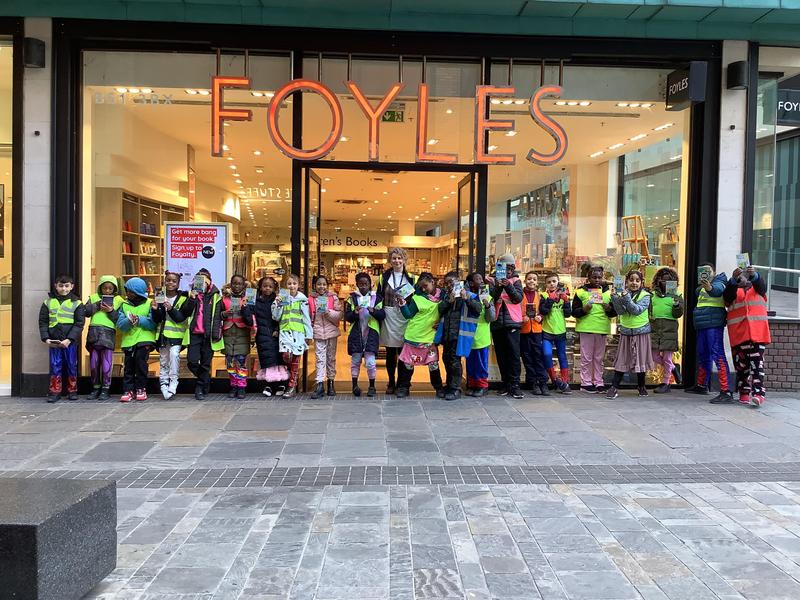 Reading Routines are fundamental for children’s progress in all areas. Each pupil has their own reading book and reading record to record comments and it is expected that pupils read at home at least 5 times a week, bringing their book in to school every day. Once pupils have passed the phonics screening check, they move on to PM benchmarking levels, which are assessed at least once a term.
Vocabulary
Staff at St Nicholas of Tolentine are passionate about vocabulary! We create a language-rich environment for pupils in every subject and in every part of our school building. We explicitly teach vocabulary as an important part of each lesson, not only in English lessons.
Oracy
If children can’t say something, we can’t expect them to write it! For this reason, we have begun to implement oracy as part of our curriculum. Pupils are taught to take it in turns to speak and listen to others, using an instigate, build, agree/disagree approach. Our teaching staff work closely with other schools in the Newman Trust to develop these skills, based on Voice21 research. Through allowing children to express their ideas verbally in all lessons, they are improving the coherence, grammar, stamina of their writing as well as their own personal confidence through the validation of their ideas.
Writing
Following the National Curriculum, pupils are taught to write for a range of fiction and non-fiction purposes with the outcomes mapped out across the year (see our English Whole School Map). Each writing outcome is linked to the key text studied, allowing children to have been immersed in the vocabulary and themes of their topic before they come to write about it. We follow a weekly writing structure of Grammar > Plan > Write > Edit. At the beginning of the sequence, a Spelling, Punctuation and Grammar objective is taken from the National Curriculum and explicitly taught, with pupils having an opportunity to practice this. We then study a model text of the intended writing outcome and allow pupils to plan their own piece before writing at length. Editing is explicitly taught, with examples given and the process modelled to pupils, giving them the skills to improve their own work independently.
Writing is assessed termly using the Newman Catholic Trust Assessment Framework. Teachers moderate termly across the trust.
Spelling
Spelling rules are explicitly taught weekly and children are given weekly spellings to practise at home.
Handwriting
We have high expectations for handwriting and presentation, with letter formation being taught daily in handwriting lessons and misconceptions addressed. We teach cursive handwriting in KS2 and it is the expectation that all pupils learn to join their letters correctly from Year 3 onwards. We follow the Unlocking Letters and Sounds handwriting scheme.
Impact
Through our bespoke English curriculum, combining the skills of Reading, Writing and Oracy, we believe all children can:
- Take pride in their work
- Become articulate communicators, effectively expressing themselves
- Write confidently for a wide range of purposes
- Develop a love of reading
- See themselves as Readers and Writers